Biggest Welfare Recipient in History Claims Welfare Is Bad for You
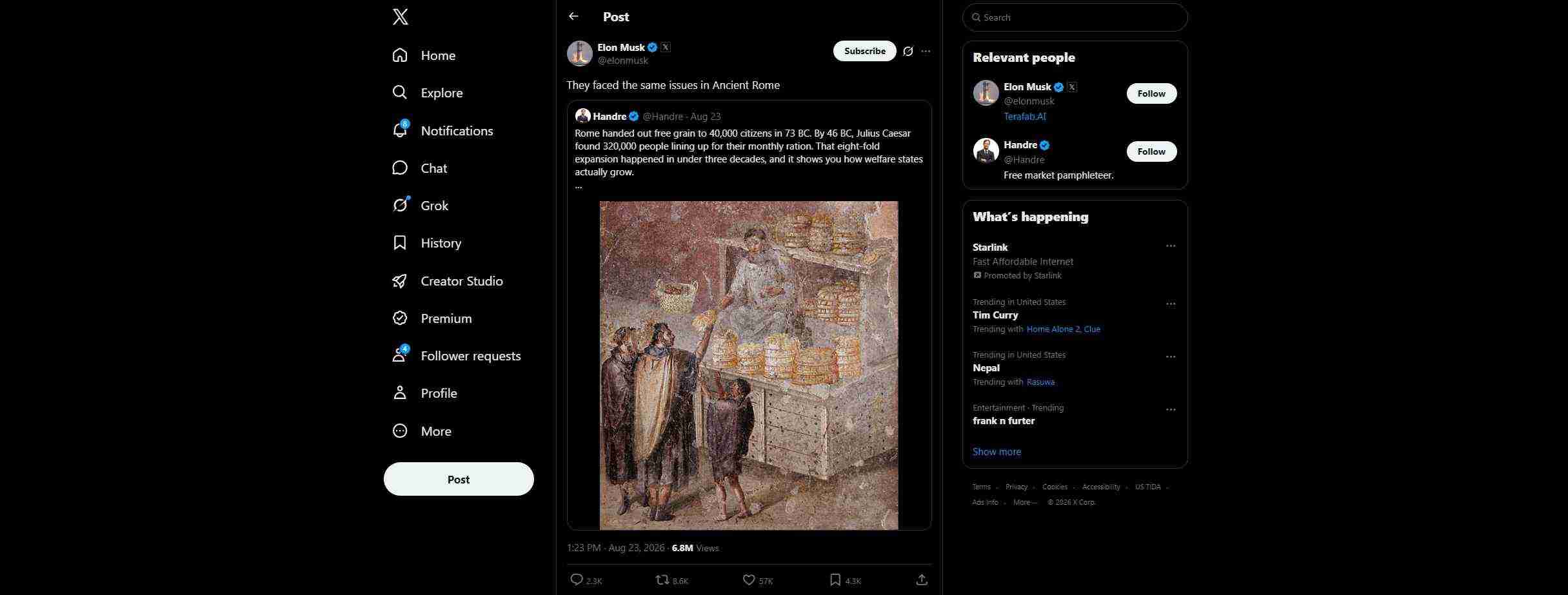
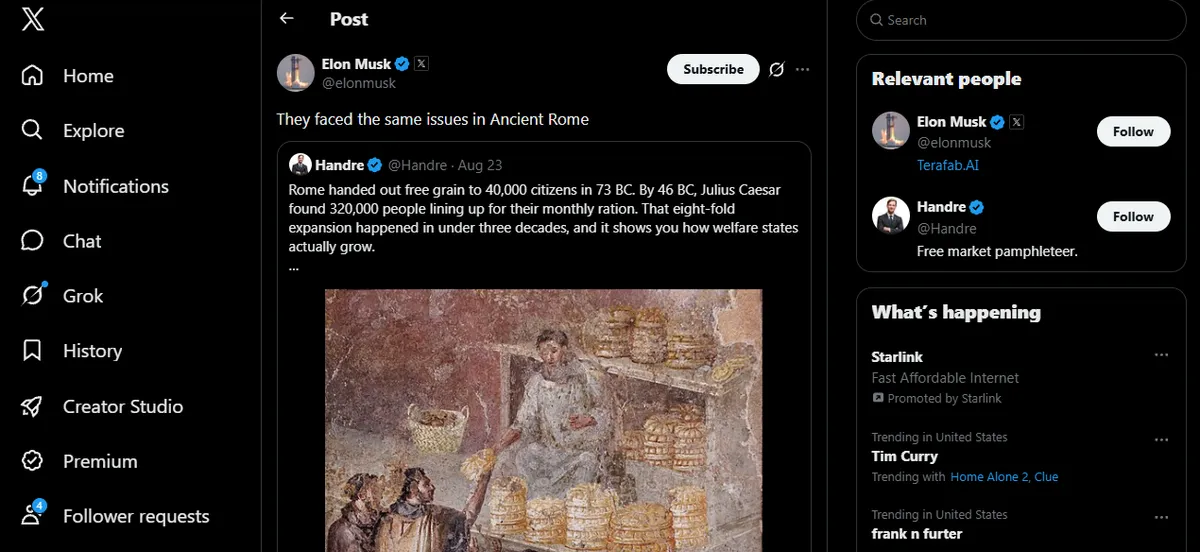
Elon Musk thinks welfare makes people dependent. He’s been boosting posts about how the Roman grain dole destroyed the empire, cheering the demolition of any program where the government helps an actual human being, and lecturing the world about how handouts corrode the soul.
Which is a hell of a position for the single biggest welfare recipient in human history.
Run the Numbers
The Washington Post did the accounting, and it’s brutal. Musk’s companies have received at least $38 billion in government contracts, loans, subsidies, and tax credits since 2003. Not “earned in the free market.” Received. From taxpayers. From the government he’s spent recent years trying to feed into a woodchipper. And that’s the floor, not the ceiling, because a chunk of his contracts are classified and can’t be counted.
- In 2010, Tesla got a $465 million low-interest loan from the Department of Energy while the company was gasping for cash. Musk personally spent hours on the phone with a government loan officer to make it happen. Without that loan, there’s a real chance Tesla doesn’t exist today.
- Tesla has pocketed $11.4 billion since 2014 selling regulatory credits, a revenue stream that exists purely because governments wrote emissions laws. For years those credit sales were the only thing standing between Tesla and red ink.
- Every Tesla buyer got $7,500 of federal money knocked off the price, plus state incentives stacked on top. That’s demand, manufactured by government checkbook.
- SpaceX’s own president, Gwynne Shotwell, estimates the company benefits from $22 billion in federal spending. NASA contracts. Pentagon launches. Starlink deals. SpaceX’s customer, patron, and rescuer at every critical moment has been the United States government.
- In 2024 alone, $6.3 billion in government money was committed to his ventures. A record year. The man was setting personal bests in welfare collection at the exact moment he was calling for the government to stop spending money on people.
So when someone tells you Musk is a self-made free-market genius, the numbers say otherwise. The richest man on Earth built his fortune on the most successful government assistance program ever run for the benefit of one guy.
What You Personally Paid
Let’s make this concrete, because “$38 billion” is one of those numbers that slides right past your brain.
Divide it up. That’s about $113 from every single American. Every man, woman, child, and newborn in the country has chipped in triple digits to help Elon Musk become the richest human who ever lived. Per household, roughly $290. And the pace is accelerating: last year’s $6.3 billion works out to almost $19 per American, meaning your family of four spent about $75 in one year subsidizing a man worth more than the GDP of most countries, whether you wanted to or not.
Now flip it around. If you handed a struggling family $290, Musk’s philosophy says you just created dependency, destroyed their work ethic, and started Rome’s collapse. But when 131 million households each hand $290 to him? That’s innovation, baby.
The Freight You Never See on the Invoice
The $38 billion is just the money we can count. The bigger subsidy is the one nobody itemizes: communal resources his companies consume at industrial scale while paying retail-citizen rates.
Start with roads. Think how many trucks Tesla alone moves around!
Pavement engineers have known since the 1950s that road damage scales roughly with the fourth power of axle weight. Double the weight on an axle and you do about sixteen times the damage, which means one loaded car hauler grinds up pavement like thousands of the sedans driving next to it. Federal cost studies have found for decades that the heaviest trucks don’t come close to covering that damage through fuel taxes and fees. Who covers the difference? You do, through the general taxes that repave the roads his delivery fleets tear down hauling Cybertrucks across the country.
Now extend that to everything else. Water for battery plants. Grid capacity for gigafactories. FAA services for rocket launches. Emergency crews standing by for every Starship test. Industrial users hammer these shared systems at rates that dwarf any household, and the pricing almost never scales to match.
That gap is a subsidy. YOU AND ME paying for shit Elon uses disproportionately – to say the least! It just never shows up on a ledger with his name on it.
The Tax Rate Insult
So he takes billions in. What does he pay back?
Tesla reported $12.6 billion in US income over the last three years and paid $48 million in current federal income tax. That’s an effective rate of 0.4 percent. Not 4 percent. Zero point four. In 2024 and again in 2025, the most valuable automaker on Earth paid precisely zero current federal income tax. The statutory corporate rate is 21 percent. Tesla pays roughly one fiftieth of that.
Musk personally? ProPublica got hold of IRS data and found that between 2014 and 2018, while his wealth grew by $13.9 billion, he paid $455 million in federal income tax. A true tax rate of 3.27 percent. In 2018 he paid zero. Nothing. The median American household pays a higher share in payroll taxes alone before they’ve bought their first cup of coffee in January.
The flow of money runs one direction. Billions in contracts, credits, and subsidies going in. A fraction coming back out. Anyone running that deficit with the government would be called a welfare case. But when Elon does it, he gets a Cabinet-adjacent office and a chainsaw!
Try Getting That Deal Yourself
Here’s the part that should piss off every small business owner in America.
I run a small manufacturing company. I employ people, I pay taxes, and I’m fighting with my own city to let me put up another building on property I already own! Permits, zoning, delays… That’s the experience of essentially every small employer in this country: the system treats you like a suspect.
But if Musk announced tomorrow that he was scouting our town for a facility? The same officials who stonewall me would be tripping over each other offering tax abatements, free land, expedited everything, and a parade.
We know this because it happens everywhere he goes: states and cities have thrown at least $1.5 billion in disclosed incentives at his companies, and the Post found nearly a dozen more state and local deals with undisclosed amounts that aren’t even counted in the $38 billion.
And who funds those sweetheart deals? The small businesses that never get them. Every dollar of tax a city forgives for a giant is a dollar it still collects from the rest of us. I’m not just competing against his scale. I’m subsidizing his discount.
The Oldest Trick in the Book
The two-step isn’t even new: subsidy for capital is “industrial policy,” subsidy for people is “moral hazard.” When billions flow to a billionaire’s rocket company, it’s visionary public-private partnership. When $6 a day flows to a single mom for groceries, it’s civilization-ending dependency.
The Gilded Age robber barons ran the identical playbook 150 years ago. Carnegie wrote an essay arguing the poor can’t be trusted with money, while he sat on tariff protection and used state militias to break strikes.
At least Carnegie built libraries as the consolation prize. Musk’s offer is worse: nothing now, robots later.
About Those Robots
Because here’s where it goes from hypocritical to incoherent. Musk’s stated vision of the future is that AI and robots take essentially all human jobs, and then everybody lives comfortably on what he calls “universal high income.”
Read that again. The man who believes food stamps create dependency believes that total income replacement for the entire human race will create paradise.
Pick one. If a $6-a-day grocery benefit destroys the human work ethic, then universal high income is the most catastrophic policy ever conceived.
If universal high income works fine, then the dependency argument he uses to attack every existing social program is garbage. Both cannot be true. He asserts both, constantly, and nobody in his replies seems to notice.
And think about who controls the checkbook in his robot utopia. It’s not some neutral abundance machine.
It’s whoever owns the robots.
A population with zero labor leverage, living entirely on distributions from automated capital owned by a handful of trillionaires, is the most dependent human population that has ever existed. Musk isn’t against dependency. He’s auditioning to be the guy you depend on.
I wonder… will the universal high income still allow the US population to be armed to the teeth?
The Bottom Line
Nobody builds anything alone. Every fortune sits on top of roads, courts, schools, research, and yes, government contracts. That’s how civilization works. What’s not fine is climbing the ladder on $38 billion of public money and then pulling the ladder up while delivering sermons about self-reliance to people who never got a Department of Energy loan when they were broke.
So the next time you see Musk sharing some post about how the Roman grain dole proves welfare destroys nations, remember: no Roman ever collected 38 billion denarii from the treasury and then lectured the plebs about handouts.
He’s not against welfare. He’s against sharing it.
One email per post. Twenty years of this, still going. Unsubscribe whenever.